
Deviated Septum Treatment in Los Angeles, From Symptoms and Diagnosis to Nasal Breathing Relief With Dr. Alen Cohen
Last Updated: September 10, 2026
Southern California Sinus Institute is a Los Angeles nasal and sinus center where board-certified ENT surgeon Alen N. Cohen, MD, FACS, FARS, evaluates and treats deviated septum and the nasal obstruction that comes with it. The office is located at 7345 Medical Center Drive, Suite 510, in West Hills in the western San Fernando Valley and serves patients from Los Angeles, surrounding Valley communities, and nearby areas. This page explains what a deviated septum is, the symptoms it can cause, how Dr. Cohen diagnoses it, the non-surgical and surgical options that may follow, and how to tell when treatment is worth considering.
Plan Your Los Angeles Consultation | Call (818) 888-7878
A Los Angeles Resource for Understanding and Treating a Deviated Septum
Patients across Los Angeles may encounter several options for evaluating nasal obstruction. Founded in 2009 and directed by Dr. Alen Cohen, Southern California Sinus Institute focuses specifically on nasal and sinus disorders. A deviated septum is evaluated alongside the turbinates, nasal valves, sinus drainage, and inflammation that may also affect breathing rather than in isolation.
The patients who come here tend to arrive with a familiar set of concerns. Some cannot breathe through one side of the nose no matter what they try. Others find their congestion flares with every cold or allergy season, and a number are active Angelenos who notice the blockage most on a run or during a restless night of sleep. Each one starts with a focused evaluation of the airway rather than a rush toward any single treatment.
What a Deviated Septum Is
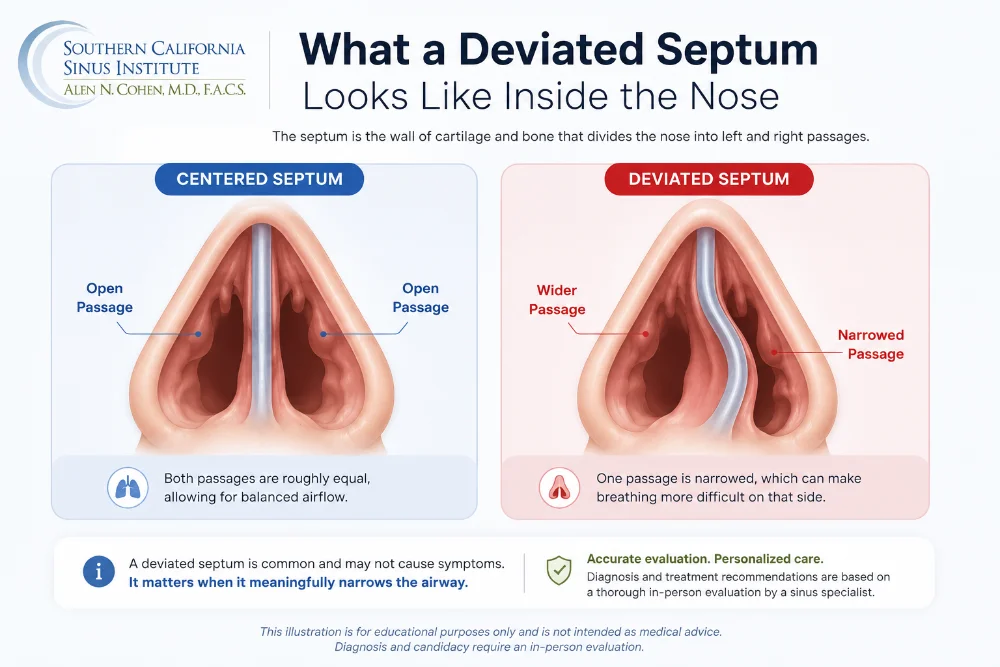
The nasal septum is the wall of cartilage and bone that divides the inside of the nose into a right and a left passage. A deviated septum is simply that wall being crooked, bent, or off center, which narrows one passage and sometimes both when the deviation is more complex.
A perfectly centered septum is uncommon, and many people have some degree of deviation without ever noticing it. The deviation becomes clinically important when it meaningfully narrows the airway and contributes to blockage, nosebleeds, or sleep-related breathing trouble. Because it is a structural problem, medicine can calm the swelling around it but cannot physically straighten it.
Deviated Septum Symptoms and When They Matter
The most common symptom is difficulty breathing through one or both sides of the nose, often more noticeable on one side. Congestion can feel worse during a cold or allergy flare because swollen tissue narrows the passage further. Other symptoms may include mouth breathing and dry mouth, noisy breathing and snoring during sleep, a preference for sleeping on one side to breathe more comfortably, and frequent nosebleeds from drying of the septal surface.
Some people notice the limitation most during exercise, when higher airflow demand makes a fixed narrowing more apparent. Facial pressure or a headache can occur, but a headache should not be blamed on the septum without an evaluation, and many deviations cause no symptoms at all and are found by chance. Because these symptoms overlap with allergies, sinus disease, and other structural issues, a diagnosis should not be made from symptoms alone.
“I have seen Dr. Cohen for several years. He is a great Dr. and explains symptoms clearly. I’d recommend him without hesitation.”
What Causes a Deviated Septum
A deviated septum can be present from birth or develop as the nose grows. It can also follow nasal trauma, such as a sports injury, a fall, a motor vehicle accident, or another blow to the face. A childhood injury may not be recognized at the time and can become more noticeable years later.
Swelling from allergies, infections, or rhinitis does not create the underlying deviation, but it can make an already narrow passage feel more blocked. Symptoms or nasal anatomy may also shift with age, which can make an existing deviation more apparent over time.
Conditions That Can Mimic or Accompany a Deviated Septum
Nasal obstruction can come from more than the septum. Enlarged or hypertrophic turbinates can narrow airflow and often coexist with a deviated septum. Nasal valve narrowing or collapse is another structural cause that can persist even after prior septum surgery. Chronic sinusitis is primarily an inflammatory condition and can cause congestion, pressure, drainage, and changes in smell.
Because more than one cause can be present at once, the evaluation looks at the septum, turbinates, nasal valves, sinus openings, and inflammation together rather than assuming the septum is the only problem. A septal deviation can produce persistent blockage that is more noticeable on one side, while chronic sinusitis may be more likely to include symptoms such as persistent drainage, smell changes, and broader facial pressure. These patterns overlap, so the diagnosis depends on examination rather than symptoms alone.
How Dr. Cohen Evaluates a Suspected Deviated Septum
A deviated septum is a clinical judgment, not a guess from symptoms alone. The evaluation is designed to determine how much the septum may be contributing to the obstruction and to identify other factors that may also affect nasal airflow.
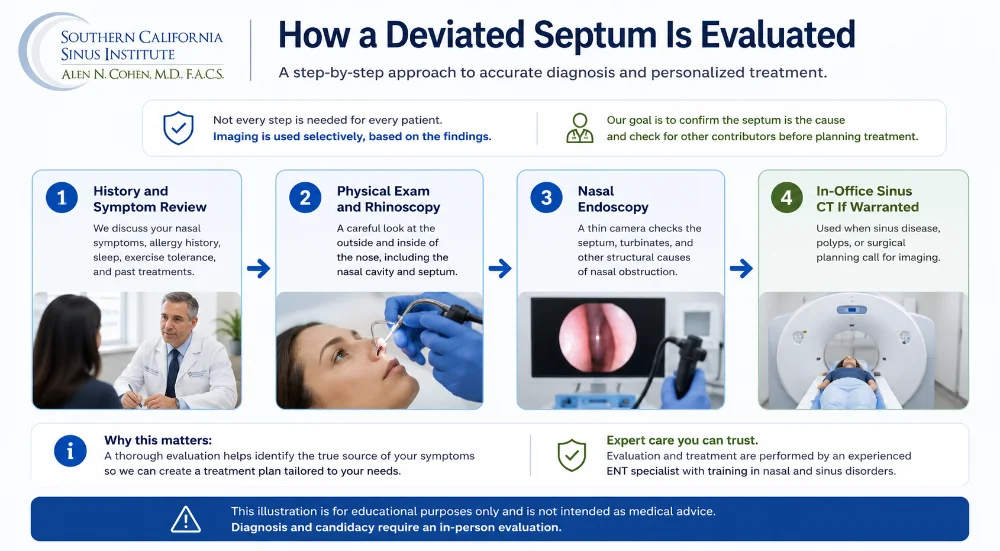
Medical History and Symptom Review
The visit starts with the story behind the symptoms: the pattern and duration of blockage, any prior nasal injury, allergies, sinus history, sleep concerns, and whether breathing feels worse during exercise. That history often points toward which side and which structures deserve the closest look.
Physical Exam and Anterior Rhinoscopy
Dr. Cohen examines the nose and inspects the front of the nasal cavity to see the position of the septum and the surrounding tissue. This first look helps gauge how much the septum is contributing compared with swelling or other structures.
Nasal Endoscopy
When nasal endoscopy is appropriate, a thin endoscope is passed through the nostril to provide a more detailed view of the septum, turbinates, sinus drainage pathways, polyps, and inflammation deeper in the nasal cavity. A topical numbing or decongestant spray may be used beforehand.
In-Office Sinus CT When Warranted
Imaging is not required for every deviated septum. An in-office sinus CT may be added when coexisting sinus disease, polyps, deeper anatomy, or surgical planning makes imaging clinically useful.
Non-Surgical Ways to Manage Deviated Septum Symptoms
Non-surgical care cannot straighten the septum, but it can make a real difference when allergies, rhinitis, or sinus inflammation are adding to the blockage. Depending on the patient and the cause of surrounding inflammation, options may include nasal steroid sprays, antihistamines, saline or sinus rinses, humidification, nasal dilator strips, and short-term decongestant use when medically appropriate. Antibiotics may be used when a bacterial sinus infection is properly diagnosed, though they do not treat the deviation itself.
Think of it this way: medicine can calm the swelling that makes a narrow passage feel narrower, but it does not change the shape of the wall inside the nose. When symptoms persist despite appropriate medical management and the examination shows that structural narrowing is an important contributor, a surgical option may enter the conversation.
What Treatment Can and Cannot Change for Your Breathing
When a deviated septum is a meaningful contributor to nasal blockage, treatment may target specific, realistic breathing concerns. It helps to know both what treatment targets and what it does not promise.
Better Airflow Through a Narrowed Passage
Straightening a septum that significantly narrows the airway is intended to improve nasal airflow. After septoplasty, temporary swelling and congestion can affect breathing during recovery, and the timing and degree of improvement vary according to the patient’s anatomy, healing, and other contributing structures.
Relief From Obstruction-Related Symptoms
When the blockage is driving mouth breathing, dryness, or persistent one-sided congestion, opening the airway may ease those symptoms. Medicine may reduce swelling from allergies or inflammation, but it does not straighten the septum itself. When structural narrowing remains an important contributor to persistent symptoms, a procedural or surgical option may be discussed.
Possible Gains in Sleep and Exercise Comfort
When nasal obstruction meaningfully contributes to snoring or exercise-related breathing difficulty, treatment may help those specific issues. It does not replace evaluation and treatment of obstructive sleep apnea, and shortness of breath during exercise can have many causes beyond the nose.
What Treatment Does Not Do
Treatment does not guarantee that every trace of congestion disappears, since turbinates, nasal valves, allergies, and sinus disease can also contribute. It is not a cure for chronic sinusitis, headaches, allergies, or sleep apnea, and a routine functional repair is not intended to change how the outside of the nose looks.
Septoplasty: A Brief Overview of the Surgical Option
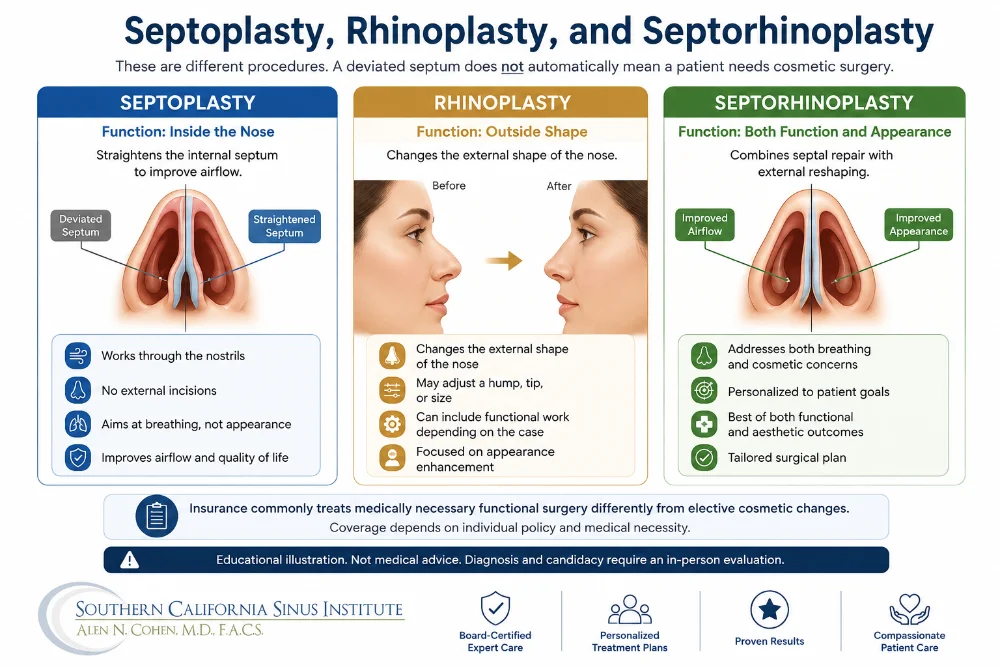
When a deviated septum is an important contributor to ongoing nasal obstruction, septoplasty may be used to correct the obstructing portion of the septum. The surgeon works mostly from inside the nose, lifting the lining and trimming or repositioning obstructing cartilage and bone. A routine functional septoplasty generally involves no external incision and no intended change to the outside of the nose, and it is typically an outpatient procedure.
It also helps to know how septoplasty differs from related procedures. Septoplasty is functional and internal, rhinoplasty changes the external shape of the nose, and septorhinoplasty combines the two when both breathing and appearance are being addressed. Turbinate reduction or nasal valve repair may be considered alongside septoplasty when those structures also contribute to obstruction.
This page keeps the surgical discussion at an overview level. For the full detail on the procedure, recovery, risks, and cost, see the dedicated Deviated Septum Repair (Septoplasty) in Los Angeles page.
When Septoplasty May Be Considered
Surgery is not necessary for a deviation that causes no symptoms. Septoplasty may be considered when there is persistent nasal obstruction that affects daily comfort, sleep, exercise, or breathing, especially when it remains after appropriate treatment of allergies or sinus inflammation. Frequent nosebleeds that are linked to the septal deviation and do not improve with appropriate medical management may also support consideration of septoplasty. A structural deformity following nasal trauma may also warrant surgical evaluation.
Just as important is who may not need surgery: patients with a mild deviation and no meaningful symptoms, patients whose congestion is mainly inflammatory and improves with medication, and patients whose blockage is driven by a different structure. The decision rests on symptoms, exam findings, competing causes, medical history, and personal goals rather than any single factor.
Understanding Cost and Insurance for Deviated Septum Care
The cost of caring for a deviated septum depends on what the visit involves, from an initial evaluation and any imaging to medical management or, if it is chosen, surgery. Functional septoplasty is often considered for insurance coverage when it is medically necessary, but deductibles, copays, documentation, and pre-authorization vary by plan, and coverage is not guaranteed. Cosmetic components, such as changes to the external shape of the nose, are generally handled separately and may be out of pocket.
The office is in network with many plans and can help verify your benefits before you commit to a plan of care. For surgery-specific cost detail, the dedicated Deviated Septum Repair (Septoplasty) in Los Angeles page is the better resource.
Why Los Angeles Patients Choose Dr. Alen Cohen for Deviated Septum Care
A thorough deviated septum evaluation involves more than confirming that the septum is off center. The clinician also needs to determine whether the septum is actually contributing to the patient’s obstruction and whether other structures are involved.
- Board-certified ENT surgeon: Dr. Cohen is a board-certified Diplomate of the American Board of Otolaryngology, Head and Neck Surgery, a Fellow of the American College of Surgeons, and a Fellow of the American Rhinologic Society.
- A dedicated nose and sinus focus: the institute concentrates on nasal and sinus disorders, so a deviated septum is evaluated alongside the turbinates, nasal valves, and sinus drainage rather than on its own.
- UCLA training and a teaching role: he earned his medical degree at the UCLA David Geffen School of Medicine, completed Head and Neck Surgery residency at UCLA Medical Center including a chief residency year, and serves as an Assistant Clinical Professor of Surgery at UCLA.
- In-office diagnostic tools: nasal endoscopy and sinus CT are available when clinically appropriate, allowing additional airway and sinus evaluation to be performed at the practice when needed.
- Minimally invasive options: for selected cases he performs limited in-office procedures under local anesthesia, and more complete surgery in an outpatient setting when it is needed.
- A conservative first approach: when symptoms are driven by allergies or inflammation, medical management is considered before surgery whenever that is appropriate.
- Recognized by peers and publications: Dr. Cohen has been named a Los Angeles Magazine Super Doctor since 2013 and recognized by Castle Connolly since 2017.
- A training center for other surgeons: the West Hills institute serves as a site where other physicians learn in-office nasal and sinus techniques.
- Care that explains as it goes: patients frequently describe the explanations they receive about their findings and treatment options, which is the experience the practice aims for at every visit.
“Dr Cohen and his staff are excellent! I’ve been a patient for a number of years, and he’s always prompt and professional, and his entire office staff is great!”
Deviated Septum and Nasal Airway Services Available to Los Angeles Patients
- Comprehensive consultation and airway examination for nasal obstruction
- Nasal endoscopy to evaluate the septum, turbinates, and sinus openings
- In-office sinus CT imaging when clinically warranted
- Blood allergy testing for environmental allergens when inflammation is suspected
- Medical management of allergy, rhinitis, and sinus inflammation contributing to congestion
- Partial or limited septoplasty under local anesthesia in the office for selected cases
- More complete septoplasty in an outpatient setting when indicated
- Inferior turbinate reduction when enlarged turbinates also narrow the airway
- Nasal valve repair for nasal valve narrowing or collapse
- Balloon sinuplasty and image-guided sinus surgery for coexisting sinus disease
- Home sleep study when snoring or sleep-related breathing is a concern
- Referral to the dedicated septoplasty resource for surgery-specific detail
Meet Dr. Alen N. Cohen, Founder and Director of the Southern California Sinus Institute
Deviated septum care at the institute is led by its founder, whose training and daily practice center on the nose and sinuses.
Alen N. Cohen, MD, FACS, FARS, Board-Certified ENT and Nasal and Sinus Surgeon
Dr. Alen N. Cohen founded the Southern California Sinus Institute in 2009 and serves as its director. He is a board-certified Diplomate of the American Board of Otolaryngology, Head and Neck Surgery, a Fellow of the American College of Surgeons, and a Fellow of the American Rhinologic Society. He earned his medical degree at the UCLA David Geffen School of Medicine and completed his Head and Neck Surgery residency at UCLA Medical Center, including a chief residency year, and he serves as an Assistant Clinical Professor of Surgery at UCLA.
His clinical focus is the medical and surgical management of nasal and sinus disorders, including deviated septum, enlarged turbinates, nasal valve narrowing, environmental allergies, and chronic sinusitis. According to the practice, he has performed thousands of in-office nasal and sinus procedures, and the West Hills institute has been designated a Stryker Balloon Sinus Center of Excellence, where he trains other physicians. He has been named a Los Angeles Magazine Super Doctor since 2013 and recognized by Castle Connolly since 2017.
“Completely satisfied with my experience. Dr. Cohen is remarkable. He explains and assures that the patient understands the procedure he has to perform from beginning to end. I’m glad I was able to find him.”
Quick Answers for Los Angeles Patients Considering a Deviated Septum Evaluation
Where will my deviated septum evaluation take place?
Care is provided at the West Hills office at 7345 Medical Center Drive, Suite 510, which serves patients from across the greater Los Angeles area and the San Fernando Valley by way of the US-101.
Do I need a CT scan at my first visit?
Not always. Many evaluations rely on history, a physical exam, and nasal endoscopy, and an in-office sinus CT is added only when coexisting sinus disease or surgical planning makes it useful.
Will I need surgery right away?
Not necessarily. When allergies, rhinitis, or sinus inflammation are contributing to symptoms, medical management may be considered first. Septoplasty is discussed when the examination suggests that structural septal narrowing is an important contributor to persistent obstruction.
Los Angeles and San Fernando Valley Communities the Institute Serves
Patients travel to the West Hills office for deviated septum care from across the greater Los Angeles area, including:
- Los Angeles, CA and the greater LA basin
- West Hills and Woodland Hills
- Canoga Park and Winnetka
- Chatsworth and Northridge
- Tarzana and Encino
- Reseda and Van Nuys
- Calabasas and the Santa Monica Mountains corridor
- Hidden Hills and Bell Canyon
- Sherman Oaks and Studio City
- Hollywood and West Hollywood
- Santa Monica and the Westside
- Downtown Los Angeles
- The US-101 Ventura Freeway corridor
- Ventura County communities near the West Valley
Breathing, Sleep, and an Active Los Angeles Life
The Los Angeles routine may include everything from outdoor activity near the Santa Monica Mountains to long workdays across the San Fernando Valley and greater Los Angeles. For patients with persistent nasal obstruction, exercise and sleep are often when restricted airflow becomes especially noticeable. Care at the West Hills office focuses on determining what may be contributing to the obstruction and discussing appropriate options when the septum is one of those factors. Weekday appointments are available for evaluation and follow-up.
Schedule a Deviated Septum Evaluation in Los Angeles
Call (818) 888-7878 or schedule online to start a consultation conversation with the Southern California Sinus Institute team. The front desk can explain appointment logistics, what to bring, and current office-access information. During the visit, Dr. Cohen determines which examination tools, including nasal endoscopy or imaging when appropriate, are needed based on the patient’s symptoms and findings. When scheduling, you can let the team know about your main concern, such as persistent one-sided blockage or symptoms that become worse at night.
- Address: 7345 Medical Center Drive, Suite 510, West Hills, CA 91307
- Website: https://www.socalsinus.com/
- Hours: Monday to Thursday 8:30 AM to 5:00 PM, Friday 8:30 AM to 3:00 PM, Saturday and Sunday closed
Call (818) 888-7878 | Plan Your Los Angeles Consultation
Southern California Sinus Institute 7345 Medical Center Drive, Suite 510, West Hills, CA 91307
Frequently Asked Questions About San Fernando Valley Sinus Treatment
How risky is fixing a deviated septum?
Septoplasty is a common outpatient procedure, but no surgery is risk free. Possible risks include bleeding, infection, a hole in the septum, a collection of blood, crusting, changes in smell, and a small chance of needing revision. Dr. Cohen reviews the risks for your specific case during a consultation.
Does a deviated septum get worse as we age?
Not always. The deviation itself is structural, but symptoms can feel more noticeable over time as the nose changes or when allergies and inflammation narrow an already tight passage. It does not inevitably worsen for everyone.
When should I worry about a deviated septum?
A deviation is worth evaluating when it causes persistent blockage on one or both sides, mouth breathing, frequent nosebleeds, disrupted sleep, or congestion that does not settle with allergy or cold treatment.
What is the main cause of a deviated septum?
Some people are born with it or develop it during growth, and others develop it after nasal trauma such as a sports injury, a fall, or an accident. A childhood injury is sometimes only noticed years later.
What can happen if a deviated septum is left untreated?
A mild, symptom-free deviation often needs no treatment. When it causes ongoing obstruction, it can contribute to poor sleep, mouth breathing, nosebleeds, and congestion, and it may make coexisting sinus or allergy symptoms feel worse. It does not automatically cause serious complications.
How do I know if my deviated septum is severe?
Severity is assessed based on how much the septum narrows the airway, how much symptoms affect breathing, sleep, and activity, and what is found during the examination. Nasal endoscopy may provide additional information when clinically appropriate.
Can a deviated septum affect your heart?
A deviated septum is a nasal airway problem, not a heart condition. When severe nasal obstruction contributes to untreated sleep-disordered breathing, poor sleep can affect overall health, which is one reason significant snoring or witnessed pauses in breathing deserve a broader evaluation.
How painful is repairing a deviated septum?
Discomfort after septoplasty varies from person to person and may include nasal pressure, congestion, tenderness, or pain during the early recovery period. The surgeon reviews the expected recovery and an individualized pain-management plan before surgery.
Can a deviated septum cause lack of oxygen to the brain?
A deviated septum narrows nasal airflow but does not by itself starve the brain of oxygen. If it contributes to significant sleep-disordered breathing, that pattern is worth evaluating, which is why persistent snoring or daytime sleepiness should be assessed.
What health problems can a deviated septum cause?
When it causes real obstruction, it can contribute to chronic congestion, mouth breathing, nosebleeds, disrupted sleep and snoring, and symptoms that overlap with sinus or allergy problems. Many deviations, though, cause no problems at all.
Can a deviated septum be fixed without surgery?
Non-surgical care cannot straighten the septum, but nasal steroid sprays, antihistamines, decongestants, and saline rinses may reduce swelling from allergies or inflammation and make breathing feel easier. Surgery may be considered when structural septal narrowing remains an important contributor to persistent symptoms despite appropriate nonsurgical management.
Can a deviated septum affect your sense of smell?
Significant blockage can reduce airflow to the part of the nose responsible for smell, so some people notice a dulled sense of smell. Smell changes can have several causes, so an evaluation helps sort out what is contributing.
Can a deviated septum cause or worsen sleep apnea?
Nasal obstruction can contribute to snoring and disrupted sleep, but a deviated septum is not the sole cause of obstructive sleep apnea. If snoring, gasping, or witnessed pauses in breathing are present, a broader sleep evaluation may be appropriate alongside nasal care.
Can allergies make a deviated septum feel worse?
Yes. Seasonal or environmental allergies swell the nasal lining, which narrows an already tight passage and can make a deviated septum feel more obstructed, especially during allergy season in Los Angeles. Allergy management may still be needed even when the septum is addressed.
Can a deviated septum change the appearance of your nose?
Not always. Many deviations are internal and are not visible from the outside, and a crooked outer nose does not always mean the internal septum is deviated. A functional septoplasty is not intended to change how the nose looks, and cosmetic concerns are addressed separately.
Deviated Septum Health Resources for Los Angeles Patients
The guides below come from the Southern California Sinus Institute team to help you understand a deviated septum, the conditions it overlaps with, and the treatment options. They are for general education and do not replace an in-person evaluation.
Living With and Treating a Deviated Septum
- Why Exercise Feels Harder With a Deviated Septum
- Deviated Septum Surgery and Seasonal Allergies
- Deviated Septum Repair (Septoplasty) Los Angeles
- Combining Septoplasty With Turbinate Reduction: Should You Do Both?
- Nasal Obstruction Treatment After Septoplasty
This page is for general education and does not replace a medical evaluation. A deviated septum should be diagnosed by a qualified clinician, and treatment decisions depend on your individual anatomy, symptoms, and health history. Do not stop any prescribed medication before surgery without guidance from your surgeon and prescribing clinician.
Deviated Septum Care Built Around Clear Answers for Los Angeles Patients
For Los Angeles patients dealing with persistent one-sided or bilateral nasal blockage, the first step is understanding what may be contributing to the obstruction. Dr. Cohen and the team examine the airway, explain the findings in plain language, and discuss appropriate non-surgical and surgical options based on the patient’s anatomy, symptoms, and goals. When you are ready to look into it, reach out and let the West Hills team take a look.
Plan Your Deviated Septum Evaluation Today
Plan Your Los Angeles Consultation | Call (818) 888-7878
Southern California Sinus Institute 7345 Medical Center Drive, Suite 510, West Hills, CA 91307
https://www.socalsinus.com/
Hours:
- Monday to Thursday: 8:30 AM to 5:00 PM
- Friday: 8:30 AM to 3:00 PM
- Saturday and Sunday: Closed